
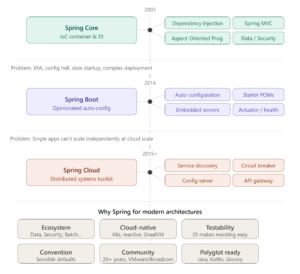
What is Spring?
Spring is an open-source application framework for Java (and JVM languages) built around two foundational ideas: Inversion of Control (IoC) and Dependency Injection (DI). Instead of your code instantiating and wiring its own dependencies, you declare what you need and the Spring container manages object creation and lifecycle for you. This makes code loosely coupled, easier to test, and simpler to reason about.
Evolution: Core → Boot → Cloud
Spring Core (2003) emerged as a lightweight alternative to the heavyweight EJB model. Rod Johnson introduced the IoC container, AOP (Aspect-Oriented Programming), and a clean MVC web layer. The problem it solved was real, but the cure had a side effect — sprawling XML configuration files that were notoriously difficult to manage.
Spring Boot (2014) tackled that directly. It introduced auto-configuration (sensible defaults inferred from your classpath), starter dependencies (a single spring-boot-starter-web pulls in everything for a web app), and embedded servers (Tomcat ships inside the JAR — no external deployment required). What used to take hours of setup became a working service in minutes. The @SpringBootApplication annotation replaced hundreds of lines of XML.
Spring Cloud (2015+) extended Boot into the distributed world. As teams moved to microservices, new problems appeared: how do services find each other? How do you manage config across dozens of instances? What happens when a downstream service is slow? Spring Cloud provided ready-made answers — Eureka for service discovery, Config Server for centralized configuration, Circuit Breakers (Resilience4j) for fault tolerance, and a Gateway for routing.
Why Spring for Modern Architectures?
The reasons it remains dominant after two decades:
Massive ecosystem — Spring Data, Spring Security, Spring Batch, Spring Integration, Spring WebFlux (reactive). Almost any cross-cutting concern has a first-class Spring module.
Cloud-native by default — Kubernetes-aware health probes (via Actuator), reactive programming with WebFlux/Project Reactor, and native compilation via GraalVM AOT (Spring Native) for fast startup and tiny memory footprints in containers.
Testability — DI is the enabler. Because dependencies are injected, swapping real implementations for mocks in tests is trivial. @SpringBootTest, @MockBean, @DataJpaTest give granular test slices without booting the whole context.
Convention over configuration — Boot’s opinionated defaults eliminate boilerplate. You override only what you must, making new service setup predictable across teams.
Stability + community — 20+ years of production hardening, maintained by VMware/Broadcom, with one of the largest Java ecosystems. Hiring is easier because Spring is what most Java developers already know.