
Apache Kafka — Topics, Partitions, and Architecture
What a Topic Actually Is
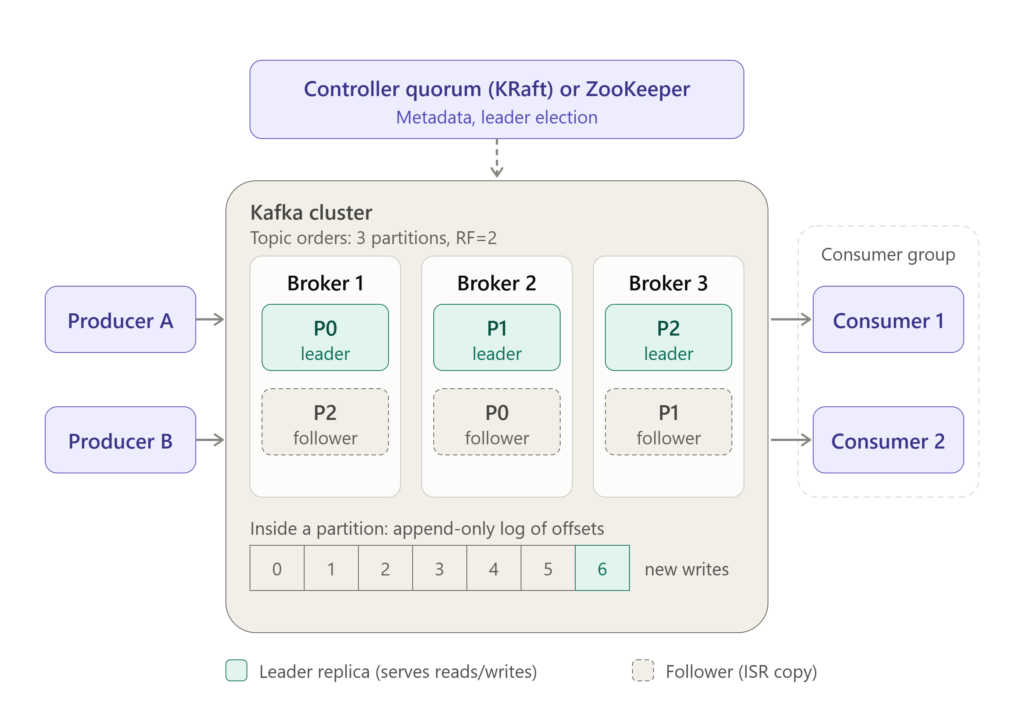
A topic is a named, append-only log — a category to which records are published. Critically, Kafka topics are partitioned: a topic isn’t one log, it’s a set of ordered logs (partitions) spread across brokers. Order is only guaranteed within a partition, never across the whole topic. This single fact drives most Kafka design decisions architects need to get right.
Topic: order-events
 ├── Partition 0: [msg0][msg1][msg4][msg7]...
 ├── Partition 1: [msg2][msg5][msg8]...
 └── Partition 2: [msg3][msg6][msg9]...
Partitions — The Real Unit of Parallelism and Ordering
- Partition count = max consumer parallelism. If a topic has 6 partitions, at most 6 consumers in one consumer group can actively read in parallel — extra consumers sit idle.
- Partition key determines ordering guarantees. Producing with a key (e.g.,
orderId) routes all records for that key to the same partition viahash(key) % numPartitions, guaranteeing per-key ordering — essential for event-sourced aggregates (you don’t wantOrderCreatedprocessed afterOrderShipped). - Choosing partition count is a one-way door (mostly). You can increase partitions later, but it breaks key-based ordering for existing keys (the hash mapping changes), and you can’t decrease partition count at all. Architects size partitions upfront based on target throughput ÷ per-partition throughput (roughly 10MB/s/partition is a common planning baseline, validate per workload) and expected consumer parallelism — not on a guess.
Replication — Durability and Availability
Each partition has:
- One leader — handles all reads/writes for that partition.
- N-1 followers — replicate the leader’s log.
Partition 0: Leader (Broker 1) → Follower (Broker 2) → Follower (Broker 3)
replication.factor(topic-level): typically 3 in production — tolerates one broker failure with no data loss when paired with correct ack settings.min.insync.replicas(min.isr): the minimum replicas that must acknowledge a write for it to be considered committed. Withreplication.factor=3andmin.insync.replicas=2, you can lose one broker and keep accepting writes safely.- Producer
ackssetting is what ties this together:acks=0— fire and forget, no durability guarantee.acks=1— leader acknowledges only (can lose data if leader fails before replication).acks=all(-1) — waits for all in-sync replicas — the only setting that, combined withmin.insync.replicas=2+, gives real durability guarantees.
Architect rule of thumb for critical data: replication.factor=3, min.insync.replicas=2, acks=all.
Retention and Cleanup Policy
Two cleanup strategies, chosen per topic via cleanup.policy:
| Policy | Behavior | Use case |
|---|---|---|
delete (default) |
Deletes records older than retention.ms or beyond retention.bytes |
Event streams, logs, telemetry |
compact |
Keeps only the latest record per key, deletes older versions | “Latest state” topics — current account balance, current order status, change-data-capture (CDC) feeds |
Compacted topics are an underused architectural tool. They let Kafka double as a durable key-value store — useful for materializing current state without a separate database, or for feeding a “latest snapshot” into a downstream cache.
Consumer Groups — How Partitions Map to Consumption
Topic: order-events (3 partitions)
Consumer Group: order-processor
 ├── Consumer A → Partition 0
 ├── Consumer B → Partition 1
 └── Consumer C → Partition 2
- Each partition is consumed by exactly one consumer within a given group at a time — this is what gives you parallel, ordered-per-key processing without explicit locking.
- Multiple consumer groups can independently read the same topic at their own pace — this is the foundation of Kafka’s pub/sub fan-out (e.g.,
order-eventsfeeding both abilling-servicegroup and ananalytics-servicegroup, independently). - Rebalancing happens when group membership changes (consumer joins/leaves/crashes) — partitions get reassigned. Frequent rebalances (“rebalance storms”) are a common production pain point, usually from overly aggressive
session.timeout.ms/max.poll.interval.mssettings or slow consumer processing — a topic an architect should know to watch for in incident postmortems.
Topic Design Patterns Architects Actually Use
- Entity-per-topic with key-based partitioning —
order-eventskeyed byorderId. Standard event-sourcing pattern. - Compacted “state” topics —
customer-current-statekeyed bycustomerId,cleanup.policy=compact, feeding a KTable in Kafka Streams or a read-side cache. - Dead-letter topics —
order-events-dltfor records that fail processing after retries, so the main topic isn’t blocked by poison messages. - Topic-per-event-type vs topic-per-aggregate — a real architectural tradeoff:
- Per-event-type (
order-created,order-shipped): simpler schemas, but loses cross-event ordering for the same entity unless you partition all of them by the same key. - Per-aggregate (
order-eventscontaining all order lifecycle events as a tagged union): preserves full ordering per entity, common in event-sourced systems, requires schema evolution discipline (see below).
- Per-event-type (
- Internal vs external topics — naming conventions like
team.domain.event-name.v1matter at scale; version in the topic name (or in the schema via a registry) so consumers can migrate without a hard cutover.
Schema Management — The Part Teams Get Wrong
Kafka itself stores bytes; it has no schema awareness. Production systems pair topics with a Schema Registry (Confluent Schema Registry, or Apicurio) using Avro, Protobuf, or JSON Schema, enforcing backward/forward compatibility rules on schema evolution. Without this, a producer deploy can silently break every downstream consumer — this is the Kafka analog of the contract-testing problem discussed earlier: the schema registry is effectively your compatibility contract for the streaming layer.
Quick Architect Checklist When Designing a New Topic
- Partition count: based on target throughput and consumer parallelism, not a round number
- Key strategy: does ordering matter? If yes, what’s the partition key?
- Replication factor + min.insync.replicas + acks: matched to the durability requirement
- Retention: delete vs compact, and how long
- Schema: registered, with explicit compatibility mode (BACKWARD/FORWARD/FULL)
- Dead-letter strategy: what happens to messages that fail processing
- Naming convention: consistent across the org, versioned